“Drink 8 glasses of water a day.” You’ve heard it a thousand times. But is it actually true? When you dig into the science, how much water you should drink per day is a more nuanced question than that simple rule suggests. Let me break this down properly.
Where Did the “8 Glasses a Day” Rule Come From?
Honestly, the origin of this recommendation is surprisingly murky. Many trace it to a 1945 U.S. Food and Nutrition Board recommendation that people consume 2.5 liters of water daily — but that same document noted that most of this amount is already contained in food.
A 2002 review by Dr. Heinz Valtin published in the American Journal of Physiology found no scientific evidence supporting the 8×8 rule as a universal requirement for healthy adults (Source: AJP).
That doesn’t mean hydration isn’t important — it absolutely is. It just means the “8 glasses” rule is an oversimplification.
What the Science Actually Says About Daily Water Intake
The most authoritative guidance comes from the National Academies of Sciences, Engineering, and Medicine, which recommends:
- Men: approximately 3.7 liters (125 oz) of total water per day
- Women: approximately 2.7 liters (91 oz) of total water per day
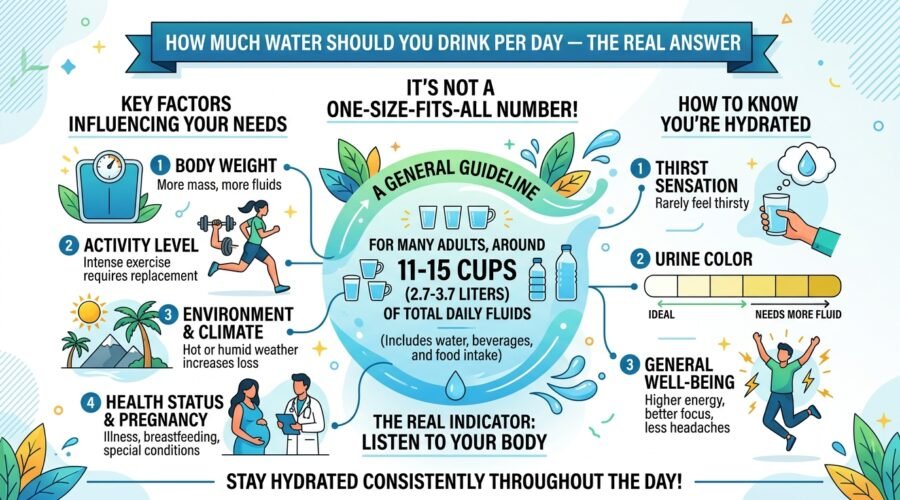
But here’s the key part — this includes all water from all sources: beverages AND food. Fruits, vegetables, soups, and other water-rich foods can account for 20–30% of total daily water intake.
So the actual amount of water you need to drink is lower than those numbers suggest.
Factors That Affect Your Personal Water Needs
There’s no universal number that works for every person. Your individual needs vary based on:
| Factor | How It Affects Water Needs |
|---|---|
| Body size and weight | Larger bodies require more water |
| Physical activity | Exercise increases water loss through sweat |
| Climate and temperature | Hot, humid conditions increase fluid needs significantly |
| Health status | Fever, vomiting, diarrhea — all increase needs |
| Diet | High fruit and vegetable intake reduces need to drink more |
| Pregnancy and breastfeeding | Significantly increased needs |
| Altitude | Higher altitudes increase respiratory water loss |
Signs You’re Not Drinking Enough Water
Your body gives you clear signals. Don’t ignore them:
- Urine is dark yellow or amber — pale yellow is ideal; dark means dehydration
- Feeling thirsty — thirst is actually a late sign of dehydration; if you’re already thirsty, you’re behind
- Headaches — a common early symptom of mild dehydration
- Fatigue and difficulty concentrating — even mild dehydration (1–2% of body weight) impairs cognitive performance
- Dry mouth and lips
- Dizziness, especially when standing up quickly
- Constipation — water keeps digestion moving
How Hydration Affects Your Body Systems
Brain Function
A 2011 study published in the British Journal of Nutrition found that women who were mildly dehydrated (1.4% body mass loss) experienced worsened mood, increased headache frequency, and poorer concentration — even without feeling thirsty (Source: BJN).
Kidney Health
Adequate hydration is essential for kidney function. Your kidneys filter about 180 liters of blood daily. Chronic low fluid intake is a significant risk factor for kidney stones and urinary tract infections.
Digestive Health
Water is essential for breaking down food and absorbing nutrients. It also prevents constipation by softening stools and supporting intestinal motility.
Joint and Muscle Function
Cartilage — the cushioning tissue in your joints — is approximately 80% water. Staying hydrated helps maintain joint flexibility and reduces exercise-related muscle cramps.
Skin Health
Dehydration affects skin elasticity and appearance. While the relationship between water intake and skin health is often overstated in beauty marketing, adequate hydration does support skin barrier function.
Does Coffee and Tea Count Toward Daily Hydration?
Yes — contrary to the old belief that caffeine was strongly diuretic, research shows that moderate caffeine consumption does not cause net dehydration. A review in Public Health Nutrition confirmed that caffeinated beverages (in normal amounts) contribute positively to total fluid intake (Source: Cambridge).
Alcohol, however, is a genuine diuretic — it suppresses the hormone that tells your kidneys to reabsorb water, leading to increased urination and net dehydration.
Practical Ways to Drink More Water Daily
- Start your day with a full glass of water before coffee or tea
- Keep a water bottle visible on your desk — out of sight, out of mind is very real
- Drink a glass before each meal
- Flavor water naturally with cucumber, lemon, mint, or berries if plain water bores you
- Set hourly phone reminders if you consistently forget
- Eat water-rich foods — watermelon, cucumber, oranges, and strawberries are excellent choices
Can You Drink Too Much Water?
Yes — though it’s rare in healthy adults. Drinking excessive amounts of water can lead to hyponatremia (low blood sodium), a condition where sodium levels in the blood become dangerously diluted.
This occurs most commonly in endurance athletes who drink large volumes of plain water during prolonged events without replacing electrolytes. For the average person with normal kidney function, drinking too much water is very unlikely.
The Mayo Clinic notes that your kidneys can process approximately one liter of water per hour — so staying well below that rate is completely safe.
Pros and Cons of Focusing on Hydration
| Pros | Cons |
|---|---|
| Improves energy and cognitive function | Easy to over-focus and create anxiety around water intake |
| Supports kidney health and toxin elimination | Individual needs vary — no universal formula |
| Aids digestion and prevents constipation | Overhydration (though rare) can be dangerous |
| May support weight loss (water before meals reduces appetite) | Frequent bathroom trips can be inconvenient |
FAQs: How Much Water Should You Drink Per Day
Q1: Does the color of my urine really indicate hydration?
Yes — it’s one of the most reliable quick indicators. Pale yellow means you’re well-hydrated. Dark yellow or amber means you need more fluids. Completely colorless can sometimes indicate overhydration.
Q2: Should I drink water even if I’m not thirsty?
In general, healthy adults can rely on thirst to guide intake. But older adults have a diminished thirst sensation, so they often need to drink on a schedule regardless of thirst.
Q3: Do I need electrolyte drinks?
For casual daily activity, no. Plain water is sufficient. Electrolyte drinks become relevant during prolonged exercise (more than 60–90 minutes), extreme heat exposure, or recovery from illness with vomiting or diarrhea.
Q4: Is sparkling water as hydrating as still water?
Yes. Sparkling water — provided it’s not loaded with sugar or sodium — hydrates just as effectively as still water.
Q5: How do I know if I’m chronically dehydrated?
Persistent headaches, low energy, frequent UTIs, dry skin, and consistently dark urine are common signs. A simple habit of checking your urine color daily for a week gives you a clear picture.
Final Thoughts
The honest answer to how much water you should drink is: enough to keep your urine pale yellow, to meet your body’s demands given your size, activity level, and environment. For most adults, that’s somewhere between 2 and 3 liters of total fluid daily — but the exact number is personal.
Don’t overthink it. Stay consistent. Your body is very good at telling you what it needs — you just have to listen.

Emma Sofia is the founder and writer of Insure Judge. She is passionate about explaining insurance topics in a simple and easy way. Her goal is to help readers make smart and confident decisions about insurance through clear, honest, and well-researched content.